
A diesel truck may be built for heavy work, but a long trip can uncover problems that do not appear during short local drives. Hours of highway travel create steady heat, while towing and heavy cargo add more strain to the engine, transmission, tires, brakes, and cooling system.
A careful inspection before leaving can reduce the chance of delays. It also gives you time to repair small issues while the truck is still close to familiar tools and services.
Review Maintenance Records
Begin with the truck’s maintenance history. Check when the engine oil, fuel filters, air filter, transmission fluid, and other major service items were last handled.
If a service will become due during the trip, completing it before departure may be easier. Follow the maintenance schedule for the truck’s engine, mileage, and operating conditions. Towing, heavy loads, dusty roads, and extended idling may fall under a severe-service schedule.
Do not rely only on a dashboard message. Look for unresolved warning lights, stored maintenance reminders, and changes in starting, power, fuel economy, or exhaust smoke.
Check Engine Oil and Other Fluids
Park on level ground and check the engine oil according to the instructions for the truck. The oil should be at the correct level. A sudden drop may point to a leak or oil consumption that deserves attention.
Inspect coolant only when the engine is cool. Look at the reservoir, hoses, clamps, radiator area, and water pump region for wet spots or dried residue. Long climbs and slow traffic can make cooling problems appear quickly.
Check transmission, brake, power-steering, windshield-washer, and differential fluids where owner inspection is permitted. Diesel exhaust fluid should also be filled if the truck uses it. Carry only fluids that meet the required specifications.
Inspect Tires and Wheels
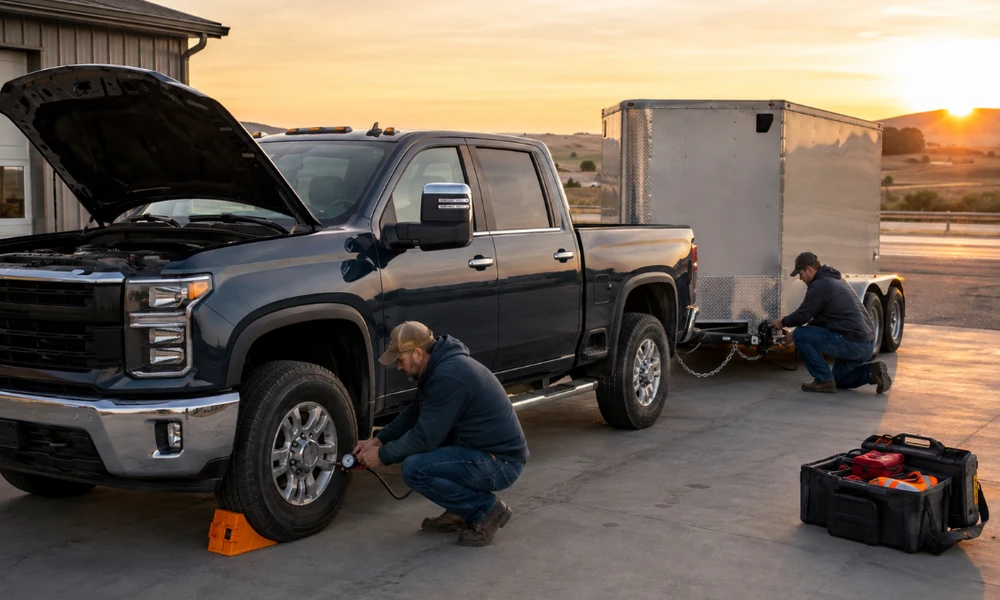
Check tire pressure when the tires are cold. Use the pressure recommended for the truck, tire size, and actual load. Do not automatically inflate every tire to the maximum number shown on its sidewall.
Inspect the tread and sidewalls for uneven wear, cuts, cracks, bulges, or exposed material. Check the spare as carefully as the tires on the road. Confirm that the jack and tools are suitable for the truck’s weight.
Look over the wheels and lug nuts. Rust trails, missing hardware, or unusual movement should be investigated before driving.
Test the Brakes and Steering
A loaded truck needs more distance to stop. Listen for grinding, scraping, air leaks, or other unusual sounds. Pay attention to a soft pedal, pulling, vibration, or changes in braking force.
Check the parking brake, steering response, mirrors, horn, wipers, lights, reflectors, and turn signals. If towing, test the trailer brakes, breakaway system, lighting connection, hitch, safety chains, and coupling hardware.
Federal pre-trip guidance for commercial vehicles specifically includes brakes, steering, lights, tires, wheels, mirrors, coupling devices, and emergency equipment. Even for a personal diesel truck, these items form a useful inspection routine.
Examine the Fuel and Air Systems
A diesel engine depends on clean fuel and steady airflow. If the fuel filters are close to their replacement point, consider changing them before the trip. Drain the water separator when required and inspect visible fuel lines for leaks.
Check the air filter, intake tubing, and clamps. Loose connections can affect performance, especially on a turbocharged engine.
Plan fuel stops before entering remote areas. Know whether the truck requires a specific diesel grade or additive in very cold conditions.
Verify the Battery and Charging System
Long trips do not guarantee that a weak battery will recover. Diesel engines often need strong batteries for starting, particularly in cold weather.
Inspect terminals for corrosion and loose connections. Check belts for cracking, glazing, or frayed edges. Test the batteries and charging system if starting has become slower or the lights change brightness unexpectedly.
Secure the Load
Confirm that cargo stays within the truck’s weight ratings. Distribute weight carefully and secure every item so it cannot shift during braking or turns.
When towing, verify the trailer’s loaded weight, tongue or pin weight, tire condition, and axle ratings. Recheck the hitch and cargo straps after the first part of the trip.
Pack for Roadside Problems
Carry warning triangles or reflective devices, a flashlight, gloves, basic tools, a first-aid kit, drinking water, chargers, and weather-appropriate clothing. Spare fuses, bulbs, a tire gauge, and an inflator may also be helpful.
Preparation cannot prevent every breakdown. Still, checking the truck carefully before departure makes a long haul safer, easier, and far less stressful.
This post was written by a professional at Kepkee’s Diesel & Performance. Kepkee’s Diesel & Performance is a full-service diesel repair company in Largo, Florida, specializing in automotive engine repairs, diagnostics, maintenance, transmission work, and performance upgrades. For drivers searching for Diesel Engine Repair Service in Clearwater, FL, our team provides dependable support throughout Pinellas County. As one of the leading diesel repair companies near you, we offer expert guidance and reliable solutions, making us a trusted choice for diesel repair near you focused on quality, value, and performance.