
When people discuss electric vehicle batteries, the conversation usually focuses on cells, charging speed, or cooling. Electrical insulation receives less attention, even though it helps keep the battery’s conductive components separated in a tightly packaged assembly.
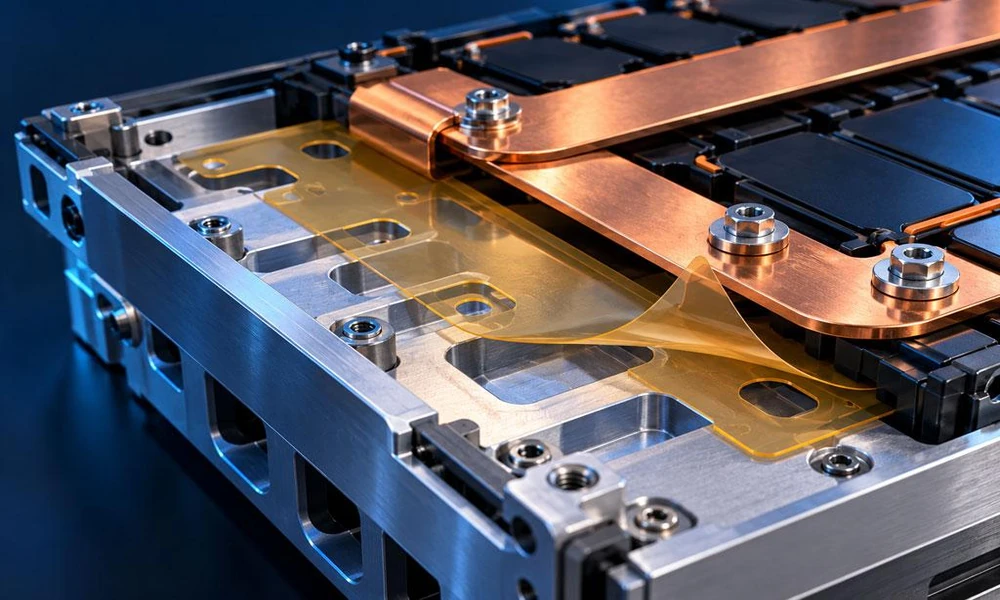
Some of these protective parts are thin sheets or films. Their modest appearance can make them seem straightforward to specify. In practice, selecting an insulation layer means considering electrical stress, geometry, temperature, and manufacturing together.
The task is to preserve a reliable insulating boundary wherever the battery design requires one.
Begin with the location
An insulation sheet can serve different purposes depending on where it is installed. A flat separator between a conductive component and a metal support faces different conditions from a formed piece around an edge or opening.
Before comparing materials, engineers should identify the surfaces that need separation, the available space, and the ways the part could move during assembly or service. Fasteners, folds, and exposed edges deserve particular attention because the nominal sheet thickness does not describe the entire installed boundary.
This location-based approach also clarifies what the sheet is expected to do. A part intended primarily for electrical separation should not automatically be treated as a structural spacer, environmental seal, or high-temperature thermal barrier.
Thinness is a constraint, not a complete specification
A thinner sheet leaves more room for neighboring components. However, the smallest available thickness is not necessarily the most suitable choice.
The design also needs sufficient resistance to electrical breakdown under the relevant test conditions, suitable mechanical durability, and dimensional stability through the manufacturing process. Handling can matter: a sheet that performs well as an undamaged sample may require additional care when it is cut, folded, or installed.
An early review of the production sequence can reveal these issues before the final part geometry is fixed. For example, an opening that simplifies installation may also leave an area of conductive material exposed. That tradeoff should be resolved in the drawing rather than improvised on the assembly line.
Flame resistance adds a separate requirement
Electrical insulation and flame resistance describe different material behaviors. A material’s ability to resist electrical breakdown does not automatically establish its response to a flame, and a flame rating does not establish its suitability for every electrical application.
PC insulation flame retardant sheet is one example of a material offered for both functions. Its battery protection materials page lists a thickness range of 0.05-1.0 mm and V-0 flame retardancy. These published properties provide a starting point for evaluating a particular grade and construction.
The next step is to confirm the applicable thickness, supporting test documentation, and electrical requirements for the intended part. A product family description should be translated into a controlled specification before production.
Geometry and processing deserve their own review
For a converted insulation component, the drawing is as important as the base material. Cut quality, hole positions, bend locations, and edge coverage can determine whether the intended separation survives assembly.
Design reviews should examine whether nearby metal edges can damage the sheet, whether the part remains located during installation, and whether temperature changes could alter its fit. If adhesive or another attachment method is used, that interface also becomes part of the evaluation.
These are practical questions about the finished component. They cannot be answered by a material name alone.
Keep the evidence connected to the final design
Material screening, component inspection, and battery validation provide different kinds of evidence. UL Solutions describes EV battery testing at cell, module, and pack levels, illustrating why material selection sits within a broader development process.
For an insulation part, useful documentation connects the selected grade and thickness to the drawing, manufacturing controls, and relevant test results. This makes later design changes easier to assess.
Thin insulation layers may be visually unremarkable, but their function is precise. Giving them a clear specification and a well-defined place in the assembly helps turn a promising material into a dependable component.
The Thin Insulation Layers That Matter Inside an EV Battery Pack